
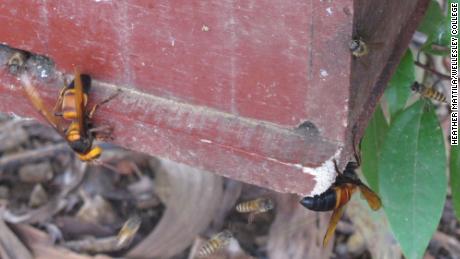
They descend en masse after a scout has recognized the goal hive, killing the defending grownup bees, occupying their nest and harvesting the bees' brood to feed to their very own younger. The marauders can decimate a hive in hours.
But honeybees aren't defenseless in opposition to the so-called murder hornets, that are native to Asia however surfaced within the United States for the primary time in 2019. The bees have their very own survival methods, together with a singular and frenetic warning sign that triggers defensive strikes, which has now been documented by scientists for the primary time.
"I feel a visceral reaction when I hear them because it is clear that the bees are agitated," stated Heather Mattila, an affiliate professor at Wellesley College's division of organic sciences, who was a part of a staff of scientists that recognized the warning noise.She described the warning sign, generally known as an "antipredator pipe," as harsh and noisy, with completely different durations and pitches just like the shrieks, screams and panic calls used by mammals like primates and meerkats when they're afraid."Individual pipes are of different durations, but workers string many of them together into longer signals. They change pitch a lot too, and in an irregular way, which makes them stand out."She stated the sound appeared for use by Asian honeybees (Apis cerana) solely when large hornets attacked the colonies in Vietnam studied by the staff. The analysis was printed within the journal Royal Society Open Science on Tuesday."Our study showed that the bees didn't make the sound if there weren't any hornets. It was made very infrequently in response to smaller hornets, a bit more often if the bees smelled a giant hornet (but didn't see one), and they made them by far the most when a giant hornet was directly outside of their nest," Mattila stated by way of e mail. "We haven't tested every predatory scenario that Asian bees might encounter, but this is good evidence that a real hornet attack is needed to trigger this response." The sign is used to set off a few of the defensive mechanisms honeybees have of their arsenal to deploy in opposition to the murder hornets, she stated. These embody methods similar to dung recognizing -- when bees gather animal poop and apply it to the entrances of their colony to repel and confuse the hornets -- and swarming to neutralize the enemy, which is named bee balling. Balling includes lots of of bees surrounding a hornet in seconds, squeezing it and constricting its means to breathe. The bees increase their physique temperature to a degree that's deadly to the hornet, Mattila defined.
 "They act like a collective overheated boa constrictor," she stated.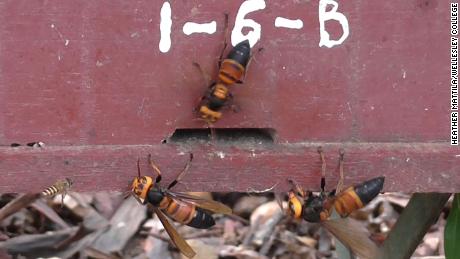
The first US sightings of the Asian large hornet occurred in Washington state in 2019. How they bought there from their native Asia is unclear -- but it surely's doable they arrived with worldwide container ships, purchases shipped into the US, or vacationers visiting or returning. There had been 14 sightings and three nests had been present in Washington state in 2021.
Unlike their Asian counterparts, Western honeybees (Apis mellifera) have not advanced any methods to fend off large hornets. "US honey bees don't have the historical experience of evolving defenses against giant hornets. We would not expect them to react with the sounds that Asian honey bees make, and they also don't perform many of the other important hornet defenses used by Apis cerana," Mattila stated. "When people use our US honey bees for beekeeping in Asia, giant hornets attack them preferentially because they are so defenseless."
Stay Tuned with Sociallykeeda.com for more Entertainment information.


![[WATCH] Rahat Fateh Ali Khan: Video of Pak Singer Beating His Student With Slipper Goes Viral](https://www.sociallykeeda.com/uploads/images/202401/image_870x_65b7c577c26e5.webp)