


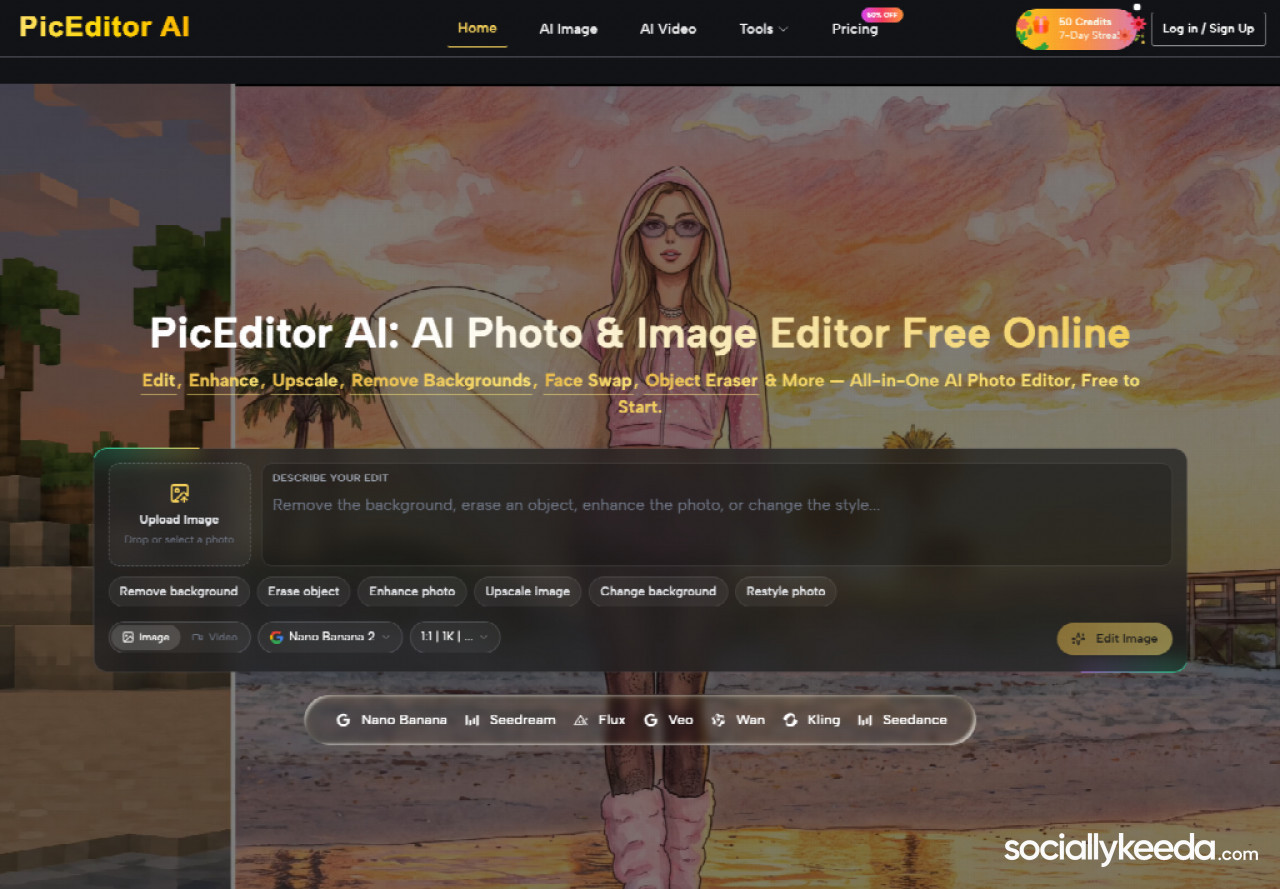
Four posts of one person fall apart when the jaw, the hairline, or the eyes belong to somebody else. A social editor who already has a portrait from the shoot, a three-quarter frame from the doorway, and two older stills doesn't need a brand-new call time. The editor needs the same face to survive a reshape of jacket, light, and room.PicEditor AI is the browser editor where that hold is a reference problem, not a reshoot.
Reshooting the set again is the expensive answer. It's usually unavailable. The person has left, the room has been reset, and the caption is already written. What the desk still has is a tiny pile of real frames. The useful question is which of those frames can pin the face while the next picture changes everything except the person. Nano Banana takes up to four reference images for that job, and the point of the slots is character consistency: the person in frame four should still be the person in frame one.
A Social Set Breaks When The Face Drifts
A short set is a promise. The reader swipes from a rehearsal doorway to a street, then to a seated portrait, and assumes the performer did all three. The assumption fails in small places, and the eyes sit higher. The smile belongs to a distinct tooth line. The hairline moves back between frame two and frame three. None of those errors needs a caption to be noticed. The swipe itself is the check.
Face drift is costly since the fix isn't a crop. A tighter frame can hide a messy background. It can't hide a person who has become a near match. Readers of an entertainment post compare faces, especially when they already know the subject from a show or a stage. A drifted still gets read as a different person, and the set loses the reason it was a set.
The old rescue is another hour on set. That hour is rework, and it misses the window in which the four posts were supposed to run together. If the references already exist, spend the edit on holding the face.
What The Four Reference Slots Are For
Four slots aren't four chances to try a mood. They're four views of one decision: who this person is, from angles the next frame might need. A single headshot can lock a front-facing smile and still fail when the next post turns the cheek. A single full-body shot can lock the outfit and still leave the eyes free to wander. The slots work when each one answers a different risk.
Read also: How To Choose Reliable Water Meter Suppliers In The UAE: A Buyer’s Checklist

Put the references in an order you can defend to another editor. The first is the face you'd hate to get wrong. The second is the same face turned. The third carries the clothes or the hair for this particular post. The fourth, if you use it, carries the place. Leaving a slot empty is better than filling it with a frame of someone else who happened to stand in the same hallway. A wrong reference teaches the edit the wrong person.
One Slot For The Face You Must Keep
The face slot should be the clearest picture you've of the eyes, the jaw. The hairline, even if the light is ordinary and the background is dull. Glamour is a later frame. Identity is this one. If the only sharp photo is slightly unsmiling, use it. A pretty frame with motion blur on the eyes is a poor anchor, since the edit will guess the eyes. Guessed eyes are where a familiar person becomes a cousin.
Don't crop this reference down to a beauty thumbnail before you upload it. Ears and the way the hair meets the forehead are part of the lock. A square that cuts them off also cuts the evidence. Keep the original proportions.
The Other Slots Hold Clothes And Place
Clothes and place are allowed to change across the set. Is why they shouldn't be stuffed into the face slot. A jacket reference tells the next frame what the cloth does at the shoulder. A room reference tells it where the person is standing. If both of those jobs are piled onto the same photo as the face, a change of jacket can tug the jaw along with it. Separate the jobs and the face has somewhere to stay.
Use the fourth slot only when the place is part of the post, such as a stage door or a recognizable street. If the next frame is a plain portrait, an extra room reference can drag that doorway into the background. Four is a ceiling, not a quota to fill with leftovers.
How Nano Banana Holds The Same Person
Nano Banana is the model on PicEditor AI that states the mechanism in plain terms: up to four reference images. Character consistency across the edits that follow. The references are the evidence. The next instruction is a tweak of clothes, light, or setting, written so it doesn't invite a new face. Preserving the person is the feature. Making a more ideal face is a different request, and it's the request that breaks a series.
-
Slot one is the clearest face, eyes and hairline included.
-
Slot two is the same person turned, so a profile doesn't get invented.
-
Slot three is the outfit or the hair for this post only.
-
Slot four is the place. Only if this frame needs that place.

Read also: How to Select Professional Equipment for Lawn Care and Landscaping Businesses
An AI Photo Editor pass then asks for the change in one sentence. "Same person, same face, now in the black jacket, standing at the stage door" can be checked against the slots. "Make her look more celebrated" can't. The second sentence has no object to preserve and no object to change. It asks for a vibe, and a vibe is how the eyes move.
Lock The Face Before The Outfit Changes
Change one variable in the sentence. If this post is about the jacket, the jacket is the variable and the face is the constant. If this post is about the room, the room is the variable. Writing both, plus a new expression, plus a closer crop, gives the edit a few reasons to rebuild the head. The series can still look polished. It won't peek like one afternoon.
Check the brand-new frame against the face slot. Don't promote it into the identity slot when the mouth is the only part that moved. A small error, copied forward, becomes the brand-new normal by post four.
Write The Next Frame As A Continuation
Continuation language is specific. Name the person as already known, then name the single alter. "Continue from the doorway portrait. Turn the body toward the street. Keep the face." That's a continuation. "Create a cinematic street portrait of a woman in her thirties" is a fresh casting, even if you uploaded references, because the sentence never points at them. The references can't do the work the sentence refuses to mention.
Read the sentence aloud before you run it. If a colleague could cast a different person from the words alone, the words are too open. Cut compliments such as luminous or ageless. They replace a real face with a stock idea of a face.
Build The Set From References Not A Reshoot
Lay the four posts out in the order they'll publish. Put the reference face above them. The set is a row: doorway, jacket, street, seated. Each frame may adjust the cloth and the background. None of them may revamp the person. This layout is the desk's review. It takes ten minutes and it replaces the argument about whether the pictures "feel like" the same shoot.
Read also: Walmart Says AI Can Personalize Shopping — Not Prices
Where a frame fails, mark the part that moved. Eyes, jaw, ear, hairline. Send that frame back with the same references and a shorter sentence that names only the part that drifted. That's cheaper than calling the person back, and it keeps the three frames that already held. A full reshoot would reset the time cost for the whole set, including the posts that were already right. Don't pay that cost for one drifted mouth.
PicEditor AI stays in the browser for this loop, so the references and the next sentence sit with the export. The person you uploaded is the person you're allowed to post.
Read The Eyes Hairline And Jaw Before Posting
The read is three points, in the same order every time, at the size the post will appear on a phone. Eyes first: the distance between them and the shape of the lid. Hairline second: where it meets the forehead in the reference, including a widow's peak or a scar the makeup didn't hide. Jaw third: the corner under the ear, not the smile. Smiles revamp on purpose. Jaws shouldn't.
Reject a frame that fails any one of the three, even if the jacket is spot-on and the caption is already typed. A wrong jacket can be described again. A wrong face can't be captioned back into the right person. Readers will believe the face over the sentence "same check out, later that night." If you wouldn't defend the still to the performer, don't defend it to the feed.
Don't leave a rejected export in the publishing row. The row should contain four faces that survive the swipe. A near match ships at midnight only when the queue is allowed to hide it.
Post The Set Only If The Person Holds
Publish the four frames when the face check passes and the captions still describe one person having one short run of pictures. Hold the set when a frame has drifted and the only remaining fix is a brand-new face you like better. Liking the new face isn't the job. The job was the person who stood in the doorway.
PicEditor AI, with Nano Banana's four reference slots aimed at character consistency, is the practical tool for that hold. It's the wrong tool when you don't have a real photograph of the person and would be asking the slots to invent one. A social set about a real appearance starts from the appearance. The references are how the later frames stay loyal to it.




Comments
No comments yet — be the first to share your thoughts.