
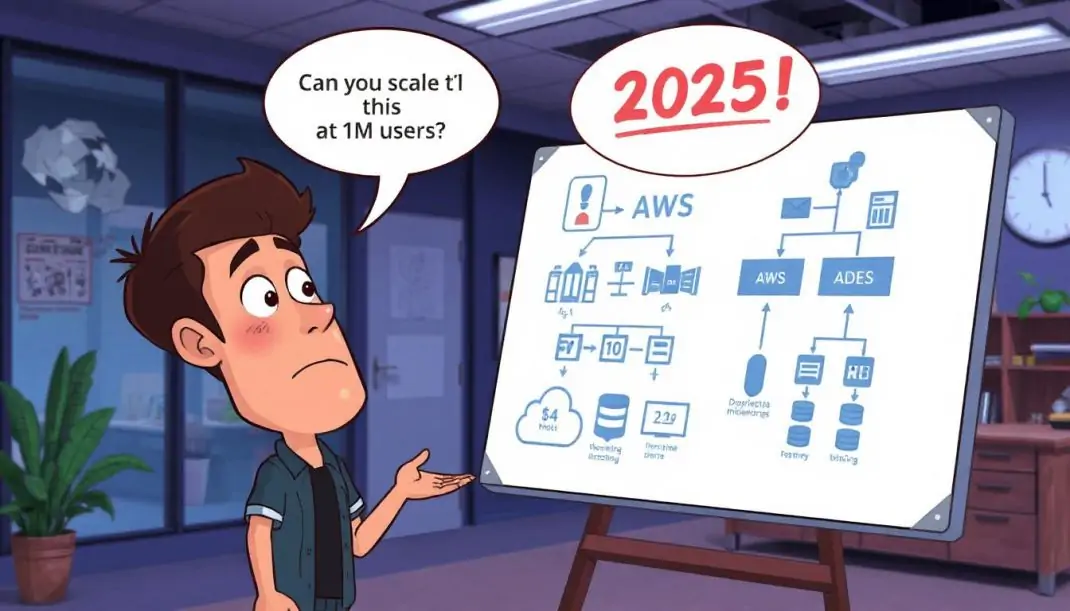
The job market in 2025 has become unpredictable. You can never be certain of what will change, to what extent, or when. So, as a junior or mid-level developer in the tech industry, have you noticed a new challenge looming on the horizon? Have you ever felt the need to learn to create a URL shortener or design an algorithm like the one used in TikTok feed?
Coding challenges have always been present; it is only now that these traditional fears have amplified due to the increasing complexities of system design interviews. This required aspiring developers to have a solid understanding of system design fundamentals. This shift in expectations raises important questions about your role as a developer. But how do these changes affect your career, and what can you do to meet these evolving demands? Let’s find out.
The great "Shift Left" - Why now?
Borrowed from DevOps, the "shift left" principle implies early movement of a process in the lifecycle. In the context of tech interviews, system design has shifted left into the purview of non-senior roles for several compelling reasons. These are:
The architectural model is microservices & cloud-native
In monolithic applications, a single codebase handles everything; however, it is only an exception, not a definitive rule. The industrial framework runs on distributed systems, which are collections of smaller, loosely coupled services (microservices) deployed in the cloud. When every feature team in the company owns a service, even a junior developer contributing to "Service A" must understand how it communicates with "Service B," what data it needs, and how its failure could impact the entire ecosystem. This makes your code more than an isolated function, but a critical part in a distributed network of services.
The abstraction of infrastructure (IaC & Serverless)
With the emergence and increasing adoption of cloud services (AWS, Azure, GCP) and other trusted platforms, the heavy lifting of provisioning physical servers is largely eliminated. Today, most infrastructure is defined and managed as code. While spinning up a database or caching a layer has become simplified, it also means that developers are expected to make data-driven choices about which service to use and how to configure it. Gone are the days when you had to build a code from scratch; modern developers are expected to provide an accurate reason for whether to use a relational (SQL) or non-relational (NoSQL) database for a given task.
What's actually expected
Clarification is necessary to prevent anxiety during interviews. As a mid-level candidate, interviewers do not expect you to design a globally distributed, fault-tolerant system with the capacity to handle a billion requests per second from memory. What they actually assess is your ability to think at scale and make reasoned, logical trade-offs. They seek:
API design prowess
They evaluate whether you can define clear, RESTful (or GraphQL) endpoints for your service. Or, if you can think about data payloads, idempotency, and versioning.
Informed data decisions
Whether you can justify your choice between PostgreSQL and MongoDB for a transactional feature, or prefer a blob storage service like S3. This decision reflects your understanding of the DSA building blocks in practice.
Basic scalability & state concepts
Whether you can articulate the reason behind putting a load balancer in front of multiple instances of your service, or clearly explain the need for a distributed cache like Redis to avoid hammering a database. Here, your reasoning and explanation demonstrate your expertise in core data structures.
Communication & structured thinking
The process is as important as the outcome. They evaluate whether you can effectively clarify requirements, identify constraints, and break down a complex problem into manageable components. This demonstrates your ability to collaborate on architectural discussions.
The foundation - How DSA informs system design
Why spend so much time on data structures and algorithms (DSA) if you're now being asked about caches and databases? DSA provides the fundamental framework for system design. Here’s how:
-
Need fast read access to user sessions? Use a hash map, the conceptual foundation for a key-value store like Redis.
-
Designing a rate limiter? Use a sliding window algorithm with a deque or a sorted set.
-
Building a feed that shows the latest posts? Using a priority queue (or a timeline) requires a heap implementation.
Suppose you are proposing a caching layer; it also means proposing a large, distributed hash map. This is where mastering DSA building blocks enables you to reason about the performance characteristics (time/space complexity) of the components you're using in your design.
Your roadmap for learning system design fundamentals
While you may feel overwhelmed learning system design, the path to fluency is clear and accessible.
Master the core concepts
Start small with the absolute basics. Have an in-depth understanding of:
-
Latency vs. throughput: The speed of one operation vs. the number of operations in a given time.
-
Availability vs. consistency: The CAP theorem basics.
-
SQL vs. NoSQL databases
-
Caching: Why and where it's used (CDN, Application, Database)
-
Load balancers & proxies
Practice with common questions
Regularly practice with small, foundational problems and progress as needed. Don't start with complex designs from the get-go. Instead:
-
Design a URL shortener (like bit.ly).
-
Design a key-value store (like Redis).
-
Design a web crawler.
These minor problems prompt you to consider APIs, data storage, and basic scaling without the architectural complexity.
Think in trade-offs
For every decision you make in a design, consider the trade-off. For example, choosing a NoSQL database for scalability may mean compromising complex queries, while adding a cache may enhance read performance but introduce complexity regarding cache invalidation. Explaining these trade-offs effectively gives you an edge.
Closure
The coding interview landscape has shifted over the years, but for the better. Today, it reflects a more holistic view of a software engineer or developer’s value as a problem-solver, not just a coder. In 2025, learning system design fundamentals is not just a mere requirement for an interview prep; it also accelerates your growth into a more capable and impactful software developer.