
Concerns about a possible bubble in the artificial intelligence sector remain one of the main topics for investors, but recent data from some of the largest companies in the AI supply chain points in the opposite direction. Foxconn’s August revenue increased by 52% and exceeded $29 billion, setting a new seasonal record. For a company that has become one of the key contract manufacturers of server equipment for Nvidia and its customers, this is an important sign that demand for AI infrastructure remains exceptionally high.
Foxconn’s revenue is expected to increase by approximately 37% in the current quarter. At the same time, the company’s second-quarter profit grew by 15%, also exceeding market expectations. Foxconn itself expects the second half of the year to be even stronger, driven by further growth in the server business.
This is especially important against the backdrop of concerns about the sustainability of the current AI investment cycle, which have already affected equity markets, including Nasdaq index futures. While the largest technology companies continue to increase their purchases of accelerators, servers, and network equipment, infrastructure manufacturers are seeing a direct boost to their financial performance. In this regard, Foxconn is particularly well positioned, as it generates revenue regardless of which AI model or service ultimately proves more successful.
Read also: Sales Methodologies: Niche-Specific Guide for Strategic Selling Case Study
However, the company’s dependence on consumer electronics remains. Foxconn is the largest assembler of Apple devices, primarily iPhones, so a possible slowdown in the smartphone market could partially offset the growth of the server segment. Nevertheless, AI infrastructure is gradually becoming a key driver of the company’s growth.
A similar trend is visible further up the supply chain at TSMC. In the second quarter, the 5‑nm process accounted for 33 % of its revenue, while the share of 3‑nm technology had already reached 30 %. In the second half of the year, 3‑nm production may become an even larger part of the company’s business, potentially generating $12.7 billion.
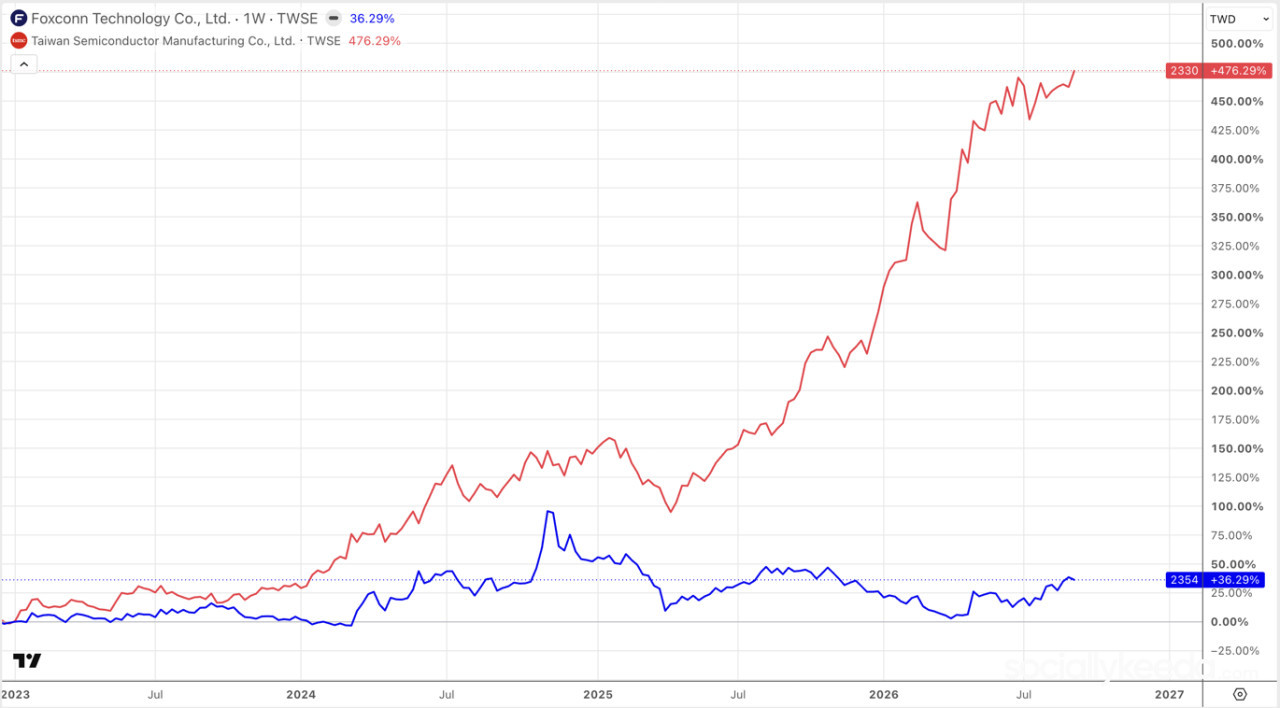
This growth is directly linked to orders from Nvidia, AMD, and Broadcom. It is estimated that TSMC’s 3‑nm production will increase from 150,000 silicon wafers per month in the first half of the year to 180,000 as early as the next quarter. By 2028, the total capacity for 2‑nm and 3‑nm technologies is expected to reach 400,000 wafers per month.
Read also: What Are Stablecoins? A Blockchain Expert Explains
This suggests the AI investment cycle extends well beyond a single quarter. Manufacturers are already investing in new factories in Taiwan, the US, and Japan, betting on multi‑year growth in demand.
Moreover, the appetite for computing resources extends far beyond traditional AI model developers. A good example is Figure AI, which entered into an agreement with Nscale to secure computing capacity in a deal initially valued at $3.5 billion, with the potential to exceed $6 billion.
For a startup that has raised about $2.2 billion since its founding, such commitments look extremely aggressive. Figure expects to gain access to 100,000 Nvidia Vera Rubin accelerators to train the Helix system, which controls humanoid robots.
Read also: Sensex, Nifty Close Higher After RBI Keeps Repo Rate Unchanged. What It Means for Investors
It is deals like these that explain why Foxconn and TSMC’s financial performance continues to strengthen despite talk of an overheated market. Demand is no longer being driven solely by OpenAI, Microsoft, or prominent names on the stock heatmap. Robotics, autonomous systems, and other capital‑intensive sectors are joining the race for computing power.
For investors, this creates a mixed picture. On the one hand, Foxconn’s growth, TSMC’s capacity expansion, and multibillion‑dollar infrastructure contracts confirm that the AI boom is still backed by real spending. On the other hand, companies are increasingly taking on massive capital commitments, betting on future demand.
Therefore, the main risk now lies not in a lack of investment, but in whether AI businesses will ultimately be able to generate enough revenue to justify the scale of the infrastructure being built. For now, equipment suppliers remain among the main financial beneficiaries of this race.